
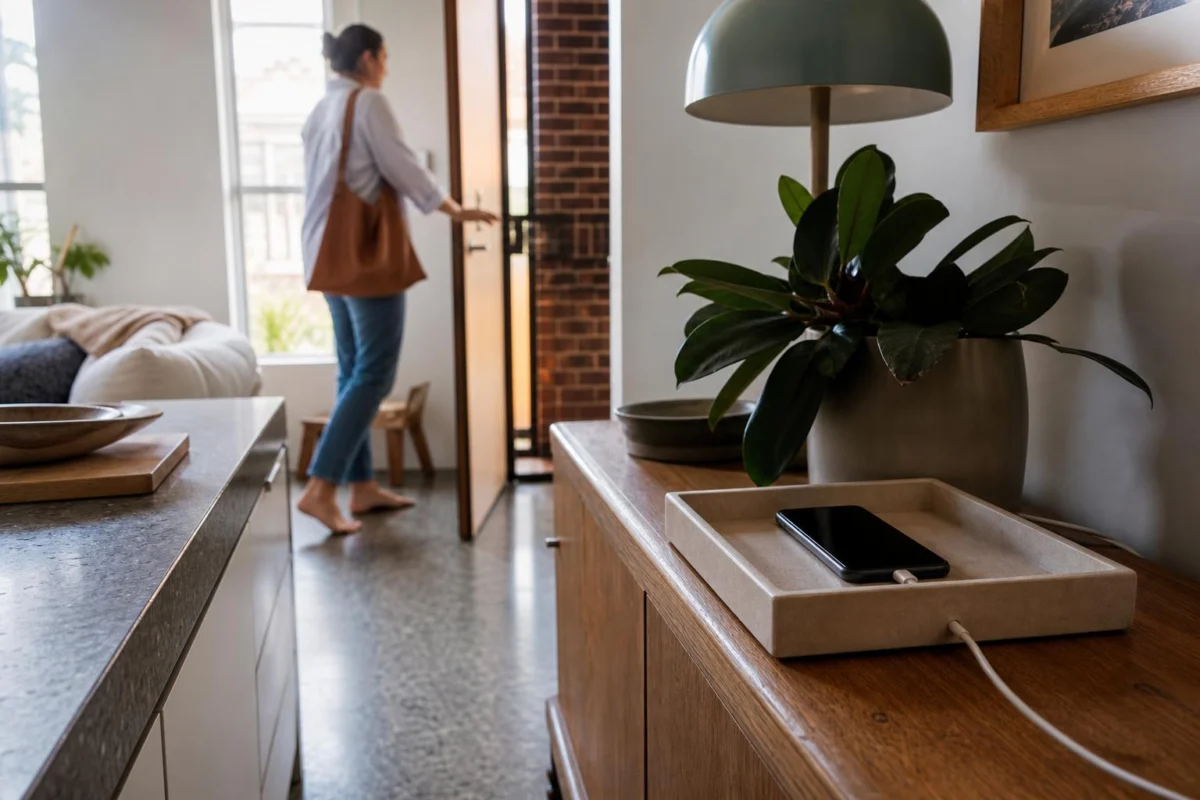
The awkward decision is not whether to own a phone or use it less. It is the repeated little choice after checking a recipe, answering a message or coming through the door: bench, pocket, sofa arm, dining table, bedside table? Without a settled answer, the phone follows the nearest empty surface.
A phone parking spot gives that decision a default. It is one recognisable place at home where the phone can sit between uses, ideally near a point it already passes through. Before it exists, the phone may turn up beside a saucepan, beneath mail or under a throw rug. Afterwards, there is one place to look and one place to put it back.
Build the spot around one return point
- Name the moment you want to change. Pick one regular transition: walking in from work, starting dinner, sitting down to eat, or moving from the kitchen to the lounge after dinner. Do not try to cover every moment the phone leaves your hand.
- Follow the route you actually take. Notice which surface is within a few steps at that point. A dining-room sideboard may suit dinner better than a hall table; a small shelf near the entry may suit arriving home better than a charger in the bedroom.
- Clear a phone-sized patch. Remove the items currently occupying it and keep the area deliberately small. A shallow tray, ceramic dish or vacant corner of a shelf makes the location easy to recognise without adding much to the room.
- Decide whether charging belongs there. If the phone regularly needs power during this part of the day, place a cable there neatly and safely. If charging happens elsewhere, leave the spot cable-free rather than creating an inconvenient second task.
- Give the spot a single cue. For example, put the phone there after the recipe is closed, once shoes are off, or before plates are brought to the table. A specific cue is easier to remember than a vague intention to put the phone away more often.
- Test it through normal evenings. If the phone keeps returning to the kitchen bench or sofa, treat that as useful information. Shift the parking spot closer to that route, or change the cue so it occurs before the old landing place takes over.
From the recipe screen to dinner
Priya uses her phone to read a pasta recipe while chopping vegetables. Once the sauce is on the stove, the phone usually stays beside the olive oil and tea towels, then gets carried to the lounge after dinner. Later, she cannot remember whether it is on the bench, in a pocket or behind a cushion.
There is a narrow sideboard between the kitchen and dining table, with a power point nearby. Priya moves a stack of unopened mail, puts a small tray on one end and adds the existing charging cable. Her cue is simple: when the recipe is no longer needed and dinner is being served, the phone goes on the tray. It remains close enough for a call to be heard, but it is no longer competing with ingredients, plates or the television remote. The sideboard becomes the obvious first place to check after the meal.
Why one visible resting place changes the room
Phones are easy to set down and easy to overlook. Their size means they slip into the activity already happening: next to breakfast, beside paperwork, on the arm of a chair, or among the things emptied from a bag. None of those surfaces is necessarily wrong, but several casual locations make the phone harder to find and keep its screen within reach of unrelated parts of the evening.
A parking spot reduces the number of decisions involved. Instead of scanning the room for a suitable patch each time, you return the phone to an established location. The physical marker matters because an empty tray or defined shelf section signals its purpose at a glance. It also protects the spot from becoming another general pile-up area.
Convenience is central. A station at the far end of the house may look tidy but will be skipped if your usual evening runs from kitchen to dining table to sofa. The more useful location is one that sits naturally along that path. It should also be stable: away from a wet sink edge, hot cooking zone, crowded food-preparation area or a surface cleared for other household jobs.
This arrangement is not about making yourself unreachable. Pick the phone up for a call, a bank transfer, a school message or directions for tomorrow, then return it to its place. If you need to hear it, choose a spot within hearing range rather than hiding it in a drawer. The point is a dependable home base, not a rule about contact.
A successful phone parking spot is close enough to use and distinct enough that it does not disappear into the rest of the room.
Decisions that help the spot stick
Should the phone parking spot be by the front door?
It can be, if taking the phone from your pocket or bag is one of the first things you do on arrival. If you routinely carry it straight to the kitchen, a nearby shelf or sideboard will probably suit better.
Is a charging station necessary for a phone parking spot?
No. Charging is useful only when it matches the time the phone is parked there. A clearly marked resting place without a cable can work well during meals or the first part of the evening.
What should be kept in the tray with the phone?
Keep it limited to items that belong with the phone, such as a charging cable or earbuds. Receipts, coins, pens and household papers quickly turn a clear signal into another place to search.
Can our household have more than one phone parking spot?
Yes, particularly where different people have different arrival routines. Start with one location per person or one shared evening location, rather than scattering several options through every room.
Leave the phone with an address at home
Clear the selected patch and place the phone there at the next cue you have chosen. The arrangement has done its job when the phone no longer lands wherever there happens to be space, and finding it after dinner starts with one ordinary, familiar surface.