
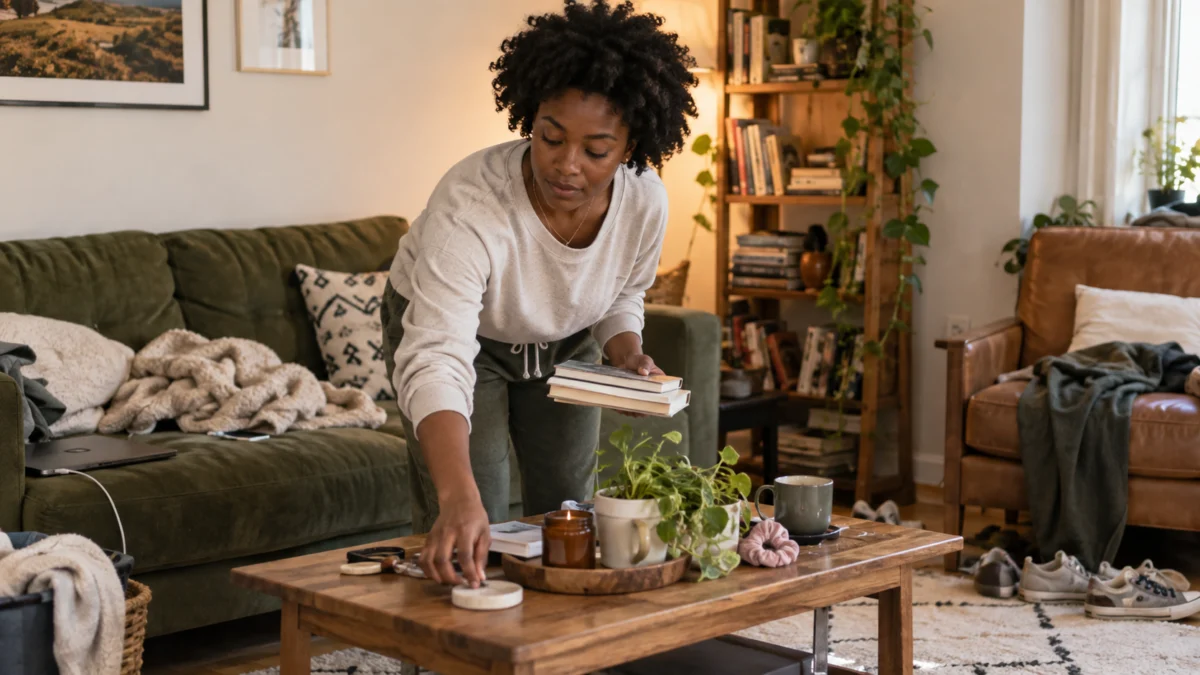
The jacket on the arm of the sofa can make the entire room feel unavailable. So can the water glasses beside it, the opened mail under a throw pillow, and the shoes angled into the walkway. None of those things may be especially large, yet together they interrupt the ways you expect to use the room: sitting down, setting down a drink, walking across it, or finding the remote.
Rather than scanning the whole room for a cleaning project, begin with the object that is physically in the way of what happens next. If you want the sofa, start with what is on it. If you need to cross the room, start with what is underfoot. Then use each object’s obvious destination to make a short map out of the mess.
Map the Mess by Where Each Object Needs to Go
- Name the blocked use. Say what you need from the room in the next hour: a seat for watching a show, a clear path to the window, a place to eat takeout, or floor space to help a child with something. Stand beside that spot.
- Remove the item sitting in that spot. Take the coat off the sofa, lift the grocery bag from the dining chair, or pick up the shoes in the route. Put it in its regular place if that place is close and clear. If it belongs in another room, place it just outside the room rather than taking a sightseeing trip through the house.
- Make three fast destination passes. On the first pass, collect trash such as wrappers, used tissues, junk mail, and empty bottles. On the second, carry dishes and cups to the kitchen counter or sink. On the third, return items with unmistakable homes, such as a remote to its tray, a blanket to its basket, or a book to its shelf.
- Park undecided objects together. Put the things that need thought in one visible, contained spot near the edge of the room: a library book due soon, a receipt you may need, a charging cable with no clear owner, or paperwork that requires reading. This is a holding group, not a sorting session.
- Check the original use before the five minutes end. Sit in the cleared seat, walk the route, or place a glass on the surface you freed. If that action now works, leave the remaining dusting, folding, and organizing alone.
A Living Room Map at 6:20 p.m.
You come home with takeout and want to eat on the couch. The sofa has a hoodie, two clean towels, and a tote bag on it. The coffee table has yesterday’s mail, a water bottle, and a few snack wrappers. A pair of sneakers sits in the narrow route between the couch and kitchen.
Start with the tote bag because it is occupying your seat. Put it by the front door if it needs to leave again tomorrow. Take the towels to the hallway linen shelf and hang the hoodie in the closet. Next, throw away the wrappers, carry the bottle to the recycling bin, and move the mail into one stack on the side table for later. Put the sneakers against the wall, then carry in your food. The rest of the room may still have a toy bin that needs attention and laundry waiting upstairs, but the couch, table, and route now serve tonight’s plan.
Why Following Objects Works Better Than Judging the Room
A room can look like one enormous problem because your eyes register every unfinished category at once: laundry, dishes, papers, shoes, cords, and surfaces. Object-by-object movement cuts that broad impression into decisions that are usually simpler. Trash leaves. Dishes travel to the kitchen. Familiar items return to their places. The few things that need a decision stay together where you can find them.
This method also limits detours. Carrying a mug to the kitchen can reveal a full dishwasher, but the mug has completed its part in the room reset once it reaches the counter. Returning a novel to its shelf may reveal other books out of order, but there is no need to rearrange the shelf. Each object has a destination; it does not automatically assign you an additional household task.
The blocked use is the useful measure because it is concrete. A room does not need to look staged to support an ordinary evening. It needs a chair that can be sat on, a walkway that does not require stepping around bags, or a tabletop that can hold dinner. Looking for that result keeps the five minutes connected to the reason you started.
If the room contains items belonging to other people, avoid making complicated ownership decisions on their behalf. Put a child’s art supplies in the bin they normally use, or gather a partner’s loose items in the temporary holding spot. The reset is about clearing access, not deciding how every possession should be stored.
Questions That Come Up in a Room-Wide Pickup
What should I do with things that belong upstairs?
Carry them upstairs only if the trip is direct and their destination is obvious. Otherwise, group them by the door so they do not keep blocking the room.
What if the object blocking me is a pile of clean laundry?
Move the pile to the room where it will eventually be put away, or place it neatly on the bed. Folding it is a separate task from reopening the living room.
Should I wipe surfaces during these five minutes?
Only wipe up a fresh spill or something sticky that affects immediate use. General dusting, polishing, and moving decorative objects can wait for a cleaning session.
What if my temporary holding spot becomes another pile?
Keep it small and visible, and use it only for items that genuinely need later attention. If it is already full, leave new undecided items where they are.
Leave the Room Ready for Its Next Use
At the five-minute mark, return to the object that started the reset. If the sofa is open, the chair is available, or the path is clear, the room is ready for what you came in to do. Take your dinner to the couch, sit with your drink, or walk through without negotiating around shoes. The remaining objects can stay for a time when you actually want to deal with them.