
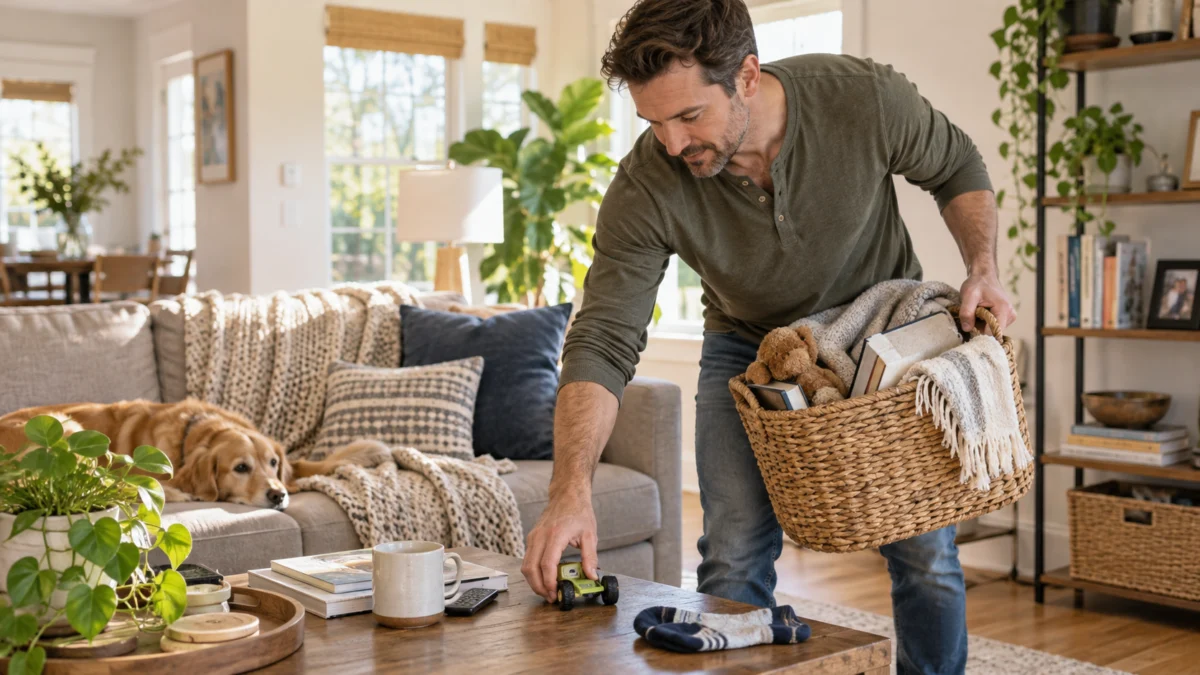
A laundry basket on the floor can create its own annoyance: it catches your foot near the sofa, blocks a cabinet door, or sits empty while scattered socks, chargers, mail, and toys send you walking back and forth through the house. The One-Basket Method gives that ordinary basket a short, specific job.
Instead of carrying each misplaced object to its room as soon as you spot it, collect the obvious strays in one basket, then make one return circuit. The room gets less interrupted by departures, and the basket does the carrying work that usually turns a quick pickup into a long series of detours.
Fill it once, walk it once
- Take an empty, easy-to-carry basket to the room you want to improve. A laundry basket, open tote, or handled bin is fine. Pick one that can hold a few everyday objects without becoming awkward to carry.
- Put in items whose next location is already clear. Add the paperback that belongs by the bed, the sweatshirt from the dining chair, a phone charger from the floor, or a child’s toy from the couch. Skip anything that requires deciding where it lives.
- Send trash, dishes, and laundry on their direct routes. Toss trash in the trash, carry a mug to the kitchen, and put dirty clothes into the hamper if it is nearby. These items have immediate destinations and do not need a ride in the basket.
- Keep your attention in the starting room until the basket has a useful load. Straighten a pillow if it is right in front of you, but do not open drawers, start sorting mail, or reorganize a shelf. The task is gathering misplaced belongings, not improving every surface.
- Carry the basket through its destinations in one sensible order. Put bedroom items away together, then bathroom items, then the items for the home office or entry. Return objects to their established places rather than trying to create new storage while standing in a doorway.
- Bring the empty basket back to where it belongs. If one object has no home, place it in a designated small holding spot and deal with that separate decision later. The basket should finish available for the next round.
A before-dinner pass through the living room
At 5:40 p.m., the living room needs to work for sitting down and getting dinner started, but the rug has a pair of sneakers, a water bottle, a library book, two building blocks, a tablet charger, and a cardigan. Bring in the laundry basket. The sneakers, library book, building blocks, charger, and cardigan go in. The water bottle goes straight to the kitchen counter to be washed.
Walk the basket first to the child’s room for the blocks, then to the bedroom for the cardigan, then to the office nook for the charger and library book. The sneakers go by the front door on the way back. A loose instruction manual has no clear home, so it goes on a small paper pile rather than traveling around in the basket for another week. The basket returns empty, the rug is open, and dinner can begin without turning the living room into a project.
Why one container cuts down the wandering
Misplaced things create friction partly because each one asks for a separate interruption. You notice a sock, walk it to the bedroom, see a glass on the nightstand, take that to the kitchen, notice mail on the counter, and suddenly the original room is still messy while three new tasks have appeared. The walking is not difficult by itself. The problem is the repeated change of location and attention.
A single basket separates collection from delivery. While you are in the room, your decision is simple: does this object plainly belong somewhere else? If yes, it goes into the basket. That keeps the pickup moving without requiring you to visit a different room after every find.
The return lap works because similar destinations can be handled together. Bedroom belongings go back in one stop rather than in four separate trips. Objects that genuinely need thought are not allowed to hold up objects with obvious homes. A mystery cable, an appliance part, or a stack of papers is a different kind of task from returning a sweatshirt to a closet.
This method also makes its limits visible. A full basket tells you there are items to return; an empty basket tells you that transport job is done. It is not meant to hide clutter under a lid or serve as a permanent catchall beside the sofa. If the same types of belongings repeatedly fill it, that is useful information: perhaps their usual storage is too far away, too crowded, or unclear.
Use the method for belongings that are out of place, not for every kind of household work. Wiping a sticky counter, loading a dishwasher, recycling shipping boxes, and sorting tax papers call for their own direct actions. Keeping those categories separate prevents the basket from becoming a mixed load that is hard to empty.
Questions that come up once the basket is in hand
What belongs in the basket and what should bypass it?
Put in portable objects with an obvious home elsewhere, such as clothing, books, toys, cords, shoes, and toiletries. Take dishes, trash, recycling, and wet or leaking items directly to their proper destination instead.
What if the basket contains items for several different rooms?
That is the intended use. Carry it in an order that follows your home’s layout, dropping off each group during one circuit rather than returning to the starting room after every item.
What should I do with something that has no obvious home?
Do not turn a quick pickup into a storage debate. Set that item in one small, visible decide-later place, then empty the rest of the basket so it remains transport rather than storage.
Can I use this method in more than one room?
Yes, if the rooms are adjacent and the basket is still manageable to carry. For a scattered whole-house pickup, begin with the room causing the most immediate inconvenience and complete that return circuit first.
Leave the basket ready, not loaded
The point of The One-Basket Method for Quick Home Resets is not to make every room look finished. It is to stop loose belongings from demanding a separate cross-house trip apiece. Collect the items with clear homes, make one delivery round, and return the basket empty. Anything left to solve is now a specific storage question, not a pile disguised as a reset.