
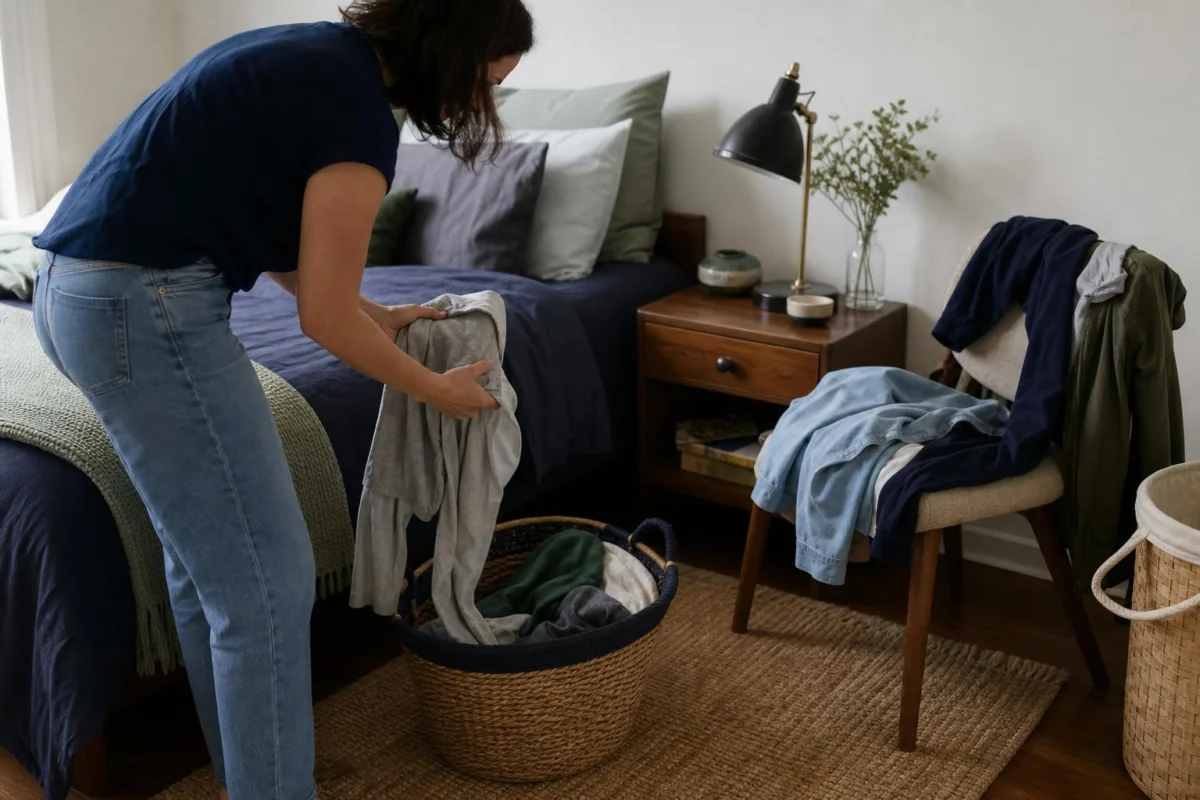
The lamp is about to go off, yet the lounge has acquired parts of the rest of the house: a school reader beside the remote, a hoodie over the armchair, a charging lead trailing near the sofa and a drink bottle by the dining chairs. Each item seems minor until taking it away means walking to a different room.
That is the awkward point where an evening pickup can turn into a long wander. On the way to put the hoodie in a bedroom, you see clothes on the floor. On the way to the study with the lead, you notice papers. A basket changes the job at that moment: gather the obvious travellers first, then make one round to return them.
This routine is for the shared spaces you are leaving behind for the night, such as the lounge, dining area and entry. It is not a whole-house tidy, a cleaning session or a chance to reorganise anybody’s room. Its narrow job is to remove belongings that have drifted away from where they are normally used or stored.
Load once, then take the return round
- Take an empty, easy-to-carry basket to the room you are already in. A small laundry basket, handled tub or shopping basket is enough. Start after dinner, while the television is off, or just before the household heads towards bed—whichever is the point when loose items are most visible.
- Look only through the shared areas in a set order. For example, move from sofa to coffee table, dining table and front door. Do not enter bedrooms, pull things from under furniture or open drawers to hunt for more.
- Add only items with an obvious home. Put in a novel that belongs by a bedside table, a child’s jumper, headphones used at a desk, sunglasses that live in an entry tray, or a toy left in the lounge. If you would need to ask whose it is or decide where it should live, leave it out.
- Send direct rubbish and kitchen items straight where they go. Put food wrappers in the bin, dishes near the dishwasher and recycling in its usual container. They do not need a ride in the basket.
- Carry the basket through the relevant rooms and drop items off. Put each thing in its normal spot, or at least in the room where that spot is located. A cardigan can land on its owner’s bed if hanging it would lead to dealing with a wardrobe.
- Return the empty basket to its starting place and stop there. The round is complete when it is empty. Leave the blanket on the sofa, the stack of magazines and any room-specific mess for another occasion.
A Tuesday-night basket round
After dinner, Mia is switching off the lounge lights. On the coffee table are a library book, her son’s sports cap and two building blocks. A phone charger sits beside the sofa; her partner’s work cardigan is over a chair. She takes the basket from beside the linen cupboard and walks the lounge, dining space and entry once.
The book, cap, blocks, charger and cardigan go into the basket. A yoghurt tub goes into recycling, and two dinner plates go beside the dishwasher. She leaves a folded throw crooked on the sofa because it belongs there, and leaves a sealed envelope on the dining table because it needs attention rather than delivery.
On the return round, the cap and blocks go into her son’s room, the cardigan goes onto the bed in the main bedroom, and the charger goes on the study desk. The library book belongs by the front door because it is due on Saturday. Once the basket is back beside the linen cupboard, the lounge is not styled or spotless. It is simply no longer holding tomorrow morning’s cap, a book that needs taking out, and objects from three other rooms.
Why the basket prevents the evening from spreading
Loose belongings create two kinds of work. There is the physical carrying, and there is the decision about what to do once you arrive somewhere else. Taking each item away immediately mixes those jobs together. A single jumper sends you to a bedroom, where other visible jobs compete for attention. By the time you return, the original pickup has lost its shape.
The basket keeps collection separate from delivery. During the first lap, the only question is whether an item is plainly out of place and has a known destination. That makes the scan quick and keeps your attention in the rooms you intended to leave. During the second lap, you are carrying a defined load rather than reacting to every surface you pass.
It also reduces repeated walking. Five items for four different places might otherwise mean several trips from the lounge. A basket lets those items travel together until the return round. In a small flat, that may save only a few steps, but it still avoids the stop-start feeling of crossing the same spaces again and again. In a family house, the difference can be more noticeable.
The rule about obvious homes matters. A mystery charging cable, a stray key, an unlabeled school notice or a toy with no settled storage spot can turn a simple pickup into a decision-making exercise. Keep a small, established holding place for those exceptions if your household needs one: perhaps a tray on a sideboard or a section of the kitchen bench. Do not put them in the basket unless the basket will also take them to a clear answer.
Dropping items in the right room rather than fully arranging them protects the routine from expanding. Returning a child’s pyjamas to their room is useful. Sorting an entire drawer because you are there is a separate task. Putting a novel on a bedside table is useful. Reordering the bookcase is not part of an evening pickup. This is why the basket can be used regularly without asking much of the end of the day.
Over a week or two, the contents can offer useful clues without requiring you to solve anything that night. If shoes appear in the basket every evening, their usual storage may be too far from the sofa or entry. If charging leads keep turning up in the lounge, one reliable charging location may help. Notice the repeated category, then consider a change at a time when you are not trying to turn off the lights.
Questions that come up during the pickup
What if the basket fills before I have finished the shared rooms?
Return the clear items already in it, then reassess. A full basket may mean the pickup area is too large for one pass, or that many belongings do not have dependable homes. There is no need to clear every surface in one evening.
Should dirty clothes go in the basket?
Only if their route is obvious and easy. If the laundry hamper is on the way, put them there. If carrying them will lead into a load of washing, leave them for the usual laundry task instead.
What if another person’s things are in the lounge?
Return them to their room or their agreed drop spot if you know it. Avoid opening bags, sorting private papers or deciding what should be discarded. The aim is relocation, not managing somebody else’s belongings.
Can I use this in the morning instead?
Yes, though it works best whenever shared rooms collect items from bedrooms, work areas and the entry. In the evening, it is especially handy because it clears belongings that might otherwise be searched for during the morning rush.
Leave the shared rooms with fewer stray belongings
One basket gives the end of the evening a contained route: collect the items that clearly belong elsewhere, carry them back together, and put the empty basket away. Once that has happened, turn off the light. The remaining blanket, papers or untidy shelf can stay exactly as they are tonight.