
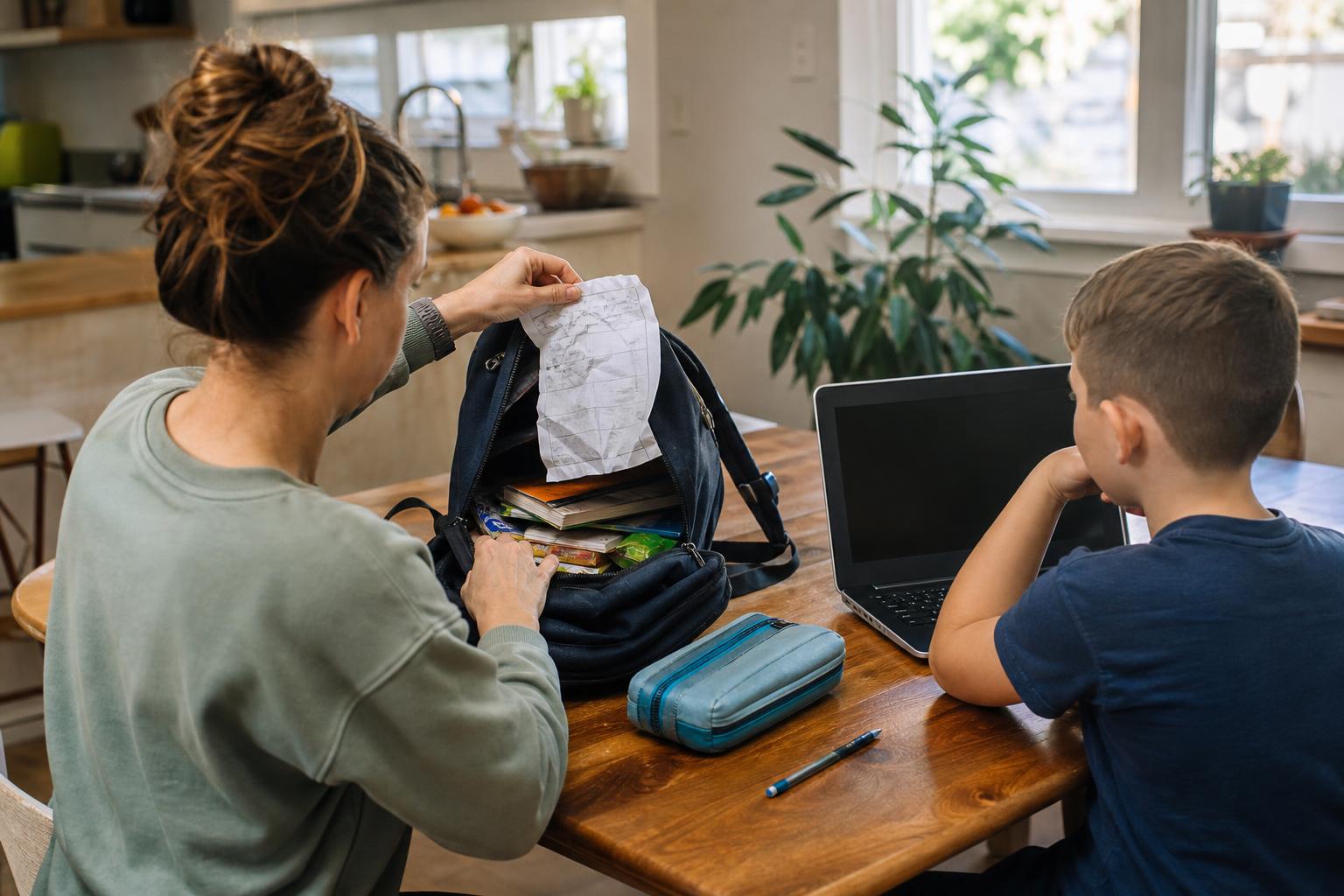
The crumpled worksheet at the bottom of the backpack is often the real obstacle, not the homework itself. A child may say they have too much to do while the assigned page is folded under a library book, a snack wrapper, and yesterday’s papers. Before discussing the whole afternoon, bring that one piece of schoolwork into view.
A dark Chromebook screen can create the same stall. If the assignment lives online, the first five minutes are for getting to the correct class page, locating today’s directions, and beginning the first requested action. This homework starting routine is about crossing the threshold into the actual assignment, not mapping every subject or finishing a full workload.
Bring one assignment from backpack to work spot
- Put the backpack where the work will happen. Set it beside the kitchen table, desk, or other regular homework surface. Open the main compartment and the front pocket rather than asking from across the room what was assigned.
- Find today’s instruction. Look at the planner, teacher portal, paper folder, or classroom app. Separate an actual assignment from permission slips, graded work, and papers that merely came home.
- Name the first assignment in plain terms. Say what is in front of you: “Read pages 18 through 22,” “Complete problems 1 through 3,” or “Write the science response.” If several items are due, begin with one that has a clear instruction or an earlier deadline.
- Clear the space directly under the assignment. Move only what prevents the page or device from sitting flat: markers, trading cards, a water bottle, stray mail, or the empty snack bag. The rest of the countertop can wait.
- Set out the materials named by the directions. Bring over the book, pencil, notebook, calculator, or charger. If a needed item is missing, identify it specifically instead of searching every room at once.
- Complete the entry action. Write the name on the worksheet, open the assigned book to the stated page, sign in to the class site, or type the response title. Then read the first direction together or let the child continue independently.
The Chromebook that is still in the backpack
At 4:45, your sixth grader says there is a history assignment and a math assignment, but the Chromebook is uncharged and buried under a hoodie. You pull out the Chromebook, plug it in at the table, and check the school portal on the available battery. History says to read one section and answer two questions due tomorrow; math is due Friday. Put the history textbook beside the device, move a cereal bowl and colored pencils away from that section of the table, and have your child open the history course and type the question numbers in the document. The work may still need attention later, but there is no longer a vague pile called homework.
Why handling the object changes the start
Homework can feel much larger than its first physical evidence. A backpack holds papers from different classes, unfinished snacks, folders, chargers, and reminders from several days. Looking at the entire bag invites broad questions: What is due? How long will this take? What happens after dinner? Those questions may matter later, but they do not reveal the next school instruction.
Taking out one worksheet or opening one course page gives the child and parent something shared to inspect. The due date, required materials, and first direction are no longer being guessed at or remembered from the car ride home. That makes it easier to distinguish a genuine problem, such as a missing book or confusing prompt, from the ordinary resistance of getting started.
The routine also keeps adult help appropriately narrow. A parent can help locate the assignment, read the directions, plug in a device, or note what is unclear. The child remains responsible for the academic response. If the directions cannot be accessed, the work seems persistently beyond the child, or an accommodation is needed, use the teacher’s established school communication process rather than trying to solve the whole assignment at the table.
Some households start homework after a snack, sports practice, or a period of downtime. That timing is a family decision. Once the agreed homework moment arrives, the useful target is concrete: one assigned item visible, its necessary tools nearby, and one opening action completed.
Beginning an avoided task can also be easier when the setup stays tightly connected to the task itself. For an adult version of that approach, see a small reset before a difficult admin task.
Homework-start questions at the table
What if the backpack has no homework folder?
Use the places your child’s school actually relies on, such as a planner, teacher portal, classroom app, or individual subject notebook. The goal is to find today’s directions, not create a new paper system during homework time.
What if my child says there is no homework?
Check the usual school source together if checking is already part of your household routine. If no assignment appears, close the backpack and move on rather than adding extra work simply to preserve the ritual.
What if the first direction is confusing?
Identify the exact point of confusion by writing down the question number, unfamiliar word, login error, or missing material. Then use the teacher’s normal help route and avoid completing the academic work for the child.
Should we always begin with the hardest subject?
Not necessarily. A clear, due-soon assignment may be the better opening because it creates immediate traction. The first five minutes are for entering real work, not enforcing one subject order every day.
For more short routines designed around school-day transitions and parent tasks, visit five-minute resets for parents.
Leave the backpack behind once the first direction is open
This routine is complete when the child has the correct assignment in front of them and has made its first required move: a name on the page, a book opened to the assigned section, or the right document on screen. Continue the homework, pause to get school-appropriate help, or return to it at the household’s planned time. The backpack does not need to be fully sorted for the start to count.