
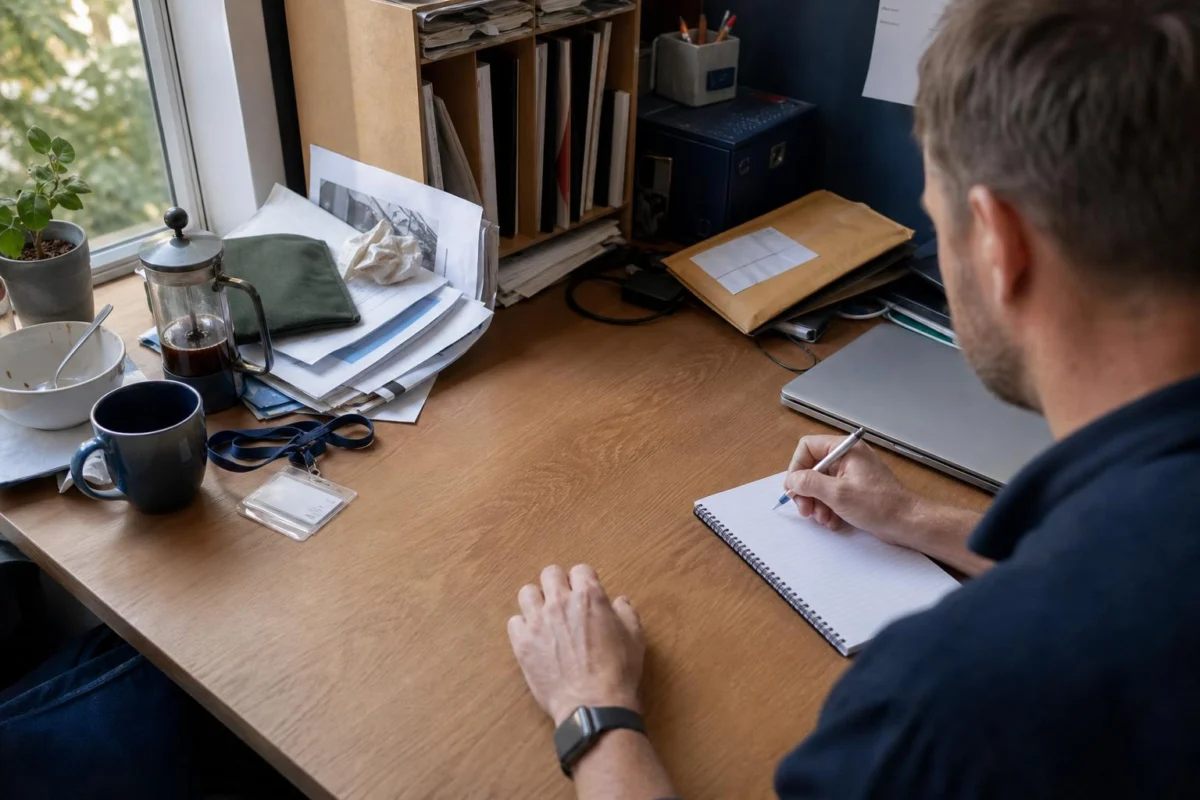
At 5.18 pm, the problem is often not that your desk is messy. It is that a half-drunk tea, an access pass, a marked-up printout, a courier envelope and your laptop are all competing for the same patch of desk. One belongs in the kitchen, one must go home, one may matter tomorrow, and one is simply in the way.
Trying to solve that pile with one rule can create another problem. Putting every item into a drawer can bury the work you need first thing; leaving every item where it landed turns tomorrow’s first minutes into a sorting job. The useful question before finishing work is: what does each object need to do between now and your return?
Trace the blockage from the desk edge inward
- Clear the items that cannot usefully stay overnight. Take away drinkware, food packaging, lunch containers and obvious rubbish. Put personal things that need to leave with you, such as keys, prescription glasses, a travel card or a parcel, directly into your bag.
- Remove anything that belongs to another shared place. Return a borrowed charger, visitor pass, reference book, headset or calculator where it is normally kept. If you cannot identify its home quickly, place it in one designated return spot rather than creating a new corner for it.
- Deal with completed material while its status is clear. Recycle spare copies, put a signed form in its normal tray, and file a document only if the destination is already known. Do not begin a broad filing session because one finished page is on the desk.
- Contain the unresolved paper trail. Put loose notes, a draft, receipts and related printouts together in a folder, tray or squared stack. Keep papers for the same matter facing the same way, with the page needing attention on top.
- Test what remains against tomorrow’s first likely move. The laptop, dock, notebook or one current document may stay if they genuinely support that move. If the morning’s priority is unknown, leave the main working area bare and keep active material together at one side.
- Make one final check below and behind the desk. Look for a phone cable caught near the chair, an access card, notes slipped behind the keyboard, or a bag that should travel home. This is a retrieval check, not an invitation to reorganise the office.
A desk with a proposal due after the weekend
It is Friday afternoon in a hybrid office. You have just finished updating a supplier proposal, but the final figures will arrive on Monday. On the desk are your laptop, a ceramic mug, an apple core, two printed versions of the proposal, handwritten notes from a phone call, a portable monitor cable, your swipe card and a tote bag containing gym clothes.
Start with the mug and apple core: they leave the desk altogether. Put the swipe card in the tote bag, and take the bag with you. Recycle the earlier proposal version. Coil the portable monitor cable and return it to the equipment cupboard if you will not need it at home.
Place the phone notes behind the current proposal, with the page listing the missing figures at the front. Put that small stack in a labelled project folder at the side of the desk, rather than across the keyboard. Leave the laptop docked and one pen nearby. On Monday, you can open the proposal and find the question still waiting, without meeting Friday’s food, duplicate pages and carry-home items first.
Why each kind of desk item needs a different answer
Desk clutter becomes tiring partly because it hides different decisions inside one visible heap. A wrapper is disposal. A visitor badge is return or carry-home. A completed document is a record. A draft with annotations is unfinished work. Treating them all as “stuff to tidy” makes the close of day feel larger and less clear than it is.
Working from the desk edge inward gives the process a useful order. Food, rubbish and personal belongings tend to be easy decisions and free space quickly. Objects owned by someone else are less likely to be forgotten if they are dealt with before you settle into papers. Only then is it worth looking at the material that tells you where the work paused.
Containing unfinished material is deliberately different from completing it. At the end of the day, you may spot a note that needs checking, a receipt that needs coding, or a question awaiting a colleague’s response. Those items do not need an immediate answer merely because they are visible. Giving them one known place prevents them from spreading across the mouse, keyboard and writing space while preserving the context you will need later.
Leaving selected work visible can also be sensible, particularly on a private desk where the next task is predictable. The point is not to create a display of intentions. It is to avoid rebuilding the work from memory. One folder and a notebook can be a helpful prompt; four unrelated projects, a pile of correspondence and several loose sticky notes are more likely to demand decisions before work can begin.
Remove the residue of the day, then preserve only a clear route back into the work.
This approach has a limit. It is not an end-of-day clean, a records-management exercise or a project review. Drawers can remain imperfect, old cables can wait, and a crowded stationery cup is not tonight’s problem. Stop after the desk has room for its ordinary functions and the remaining items have an understandable reason for being there.
Desk-close problems worth solving
Should I leave my current notebook open overnight?
Leave it open only if the desk is private and the page gives you a useful starting point tomorrow. Otherwise close it and keep it with the relevant folder.
What if my desk is shared or hot-desked?
Take away all personal, confidential and active work materials, even if you expect to return soon. Use a labelled folder, locker or approved storage place instead.
Where should a document go if I am waiting for someone else to reply?
Put it with the project materials in one review location, and add any necessary follow-up to your normal work record. It does not need to remain loose.
Do I need to wipe down the desk before leaving?
Wipe it if there is a spill, crumbs or a shared-workspace expectation. A routine surface clean is separate from deciding which objects should remain available.
Finish with a desk that has one clear purpose
Before you leave, remove what is rubbish, food, personal carry-home gear and clearly finished work; return borrowed equipment; and gather unfinished material so it is not scattered. Then look at the centre of the desk. It should hold either the few things needed to resume a known task or simply open room for whatever arrives next. Once that is true, leave the rest for another time.