
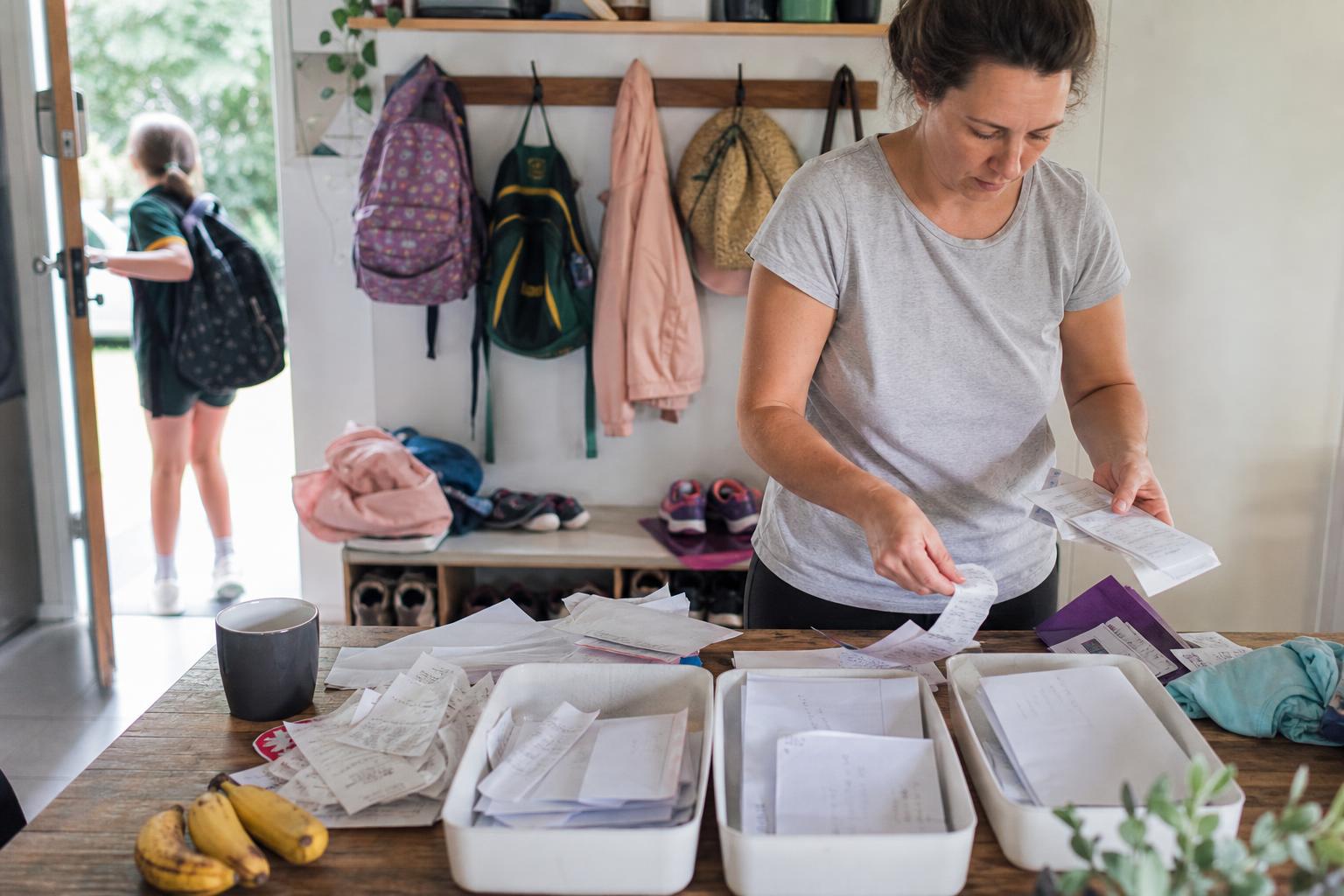
An after-school drop zone is a small, repeatable storage setup near the door your family actually uses. It gives backpacks, shoes, damp jackets and important school papers known places to land, instead of letting them spread from the hallway to the kitchen. You do not need a renovated mudroom or a wall of matching baskets: start by finding out where the pile already forms.
This guide is about setting up the space once and adjusting it when it fails. If everyone is already home and you need to decide whether snack, homework or an activity comes next, that is a separate parent reset after school.
Pick the entrance that catches the real mess
For two school days, notice which door the bags come through and where they are dropped first. It may be the garage entry, a hallway corner, or the end of the kitchen bench. The best drop zone is close to that route, not necessarily the prettiest wall in the house.
Check whether the space is safe to use. Keep exits and walking paths clear, avoid unstable furniture and do not hang heavy bags from fittings that cannot support them. If the entrance is too narrow for storage, use the nearest adjacent wall or room rather than filling the doorway.
Set up four simple destinations in five minutes
- Backpacks: Choose a reachable hook, a sturdy low shelf or a clearly defined patch below a bench. Give each child’s bag a recognisable place. A hook is not essential if the bags are too heavy for it.
- Shoes: Use a mat, shallow tray or existing basket off the walking route. The aim is to stop shoes scattering into the route to the kitchen, not to organise every pair in the house.
- Wet layers: Identify a drying spot for jackets and umbrellas. Do not stuff damp clothing into an enclosed bag or basket just to make the entrance look tidy.
- Papers requiring an adult: Use one small visible folder or tray for forms that need signing, payment, calendar action or a reply. Keep everyday worksheets and artwork out of it so the urgent items remain easy to notice.
If you already have hooks and a mat, use them first. Buying matching organisers should not be step one.
Test the layout with a real arrival
Imagine two children coming in through the garage. One bag is large enough to knock against the wall, one child cannot reach the upper hook, and the shoes end up under the bench. Move the upper hook’s job to the low shelf or assign the reachable hook to the smaller bag. Shift the shoe mat where feet naturally stop. Put the response-paper tray on the path to the kitchen where an adult will see it.
Now walk through the entrance with a bag in each hand. Can someone get past you safely? Can the children use their assigned spots without moving another person’s belongings? If not, reduce the number of things the zone stores. Sports equipment used once a week can have a separate home.
Give the system a one-sentence instruction
Use an instruction tied to locations: "Backpack on the shelf, shoes on the mat, papers in the tray." A child can learn one clear route more easily than a request to clean up everything from school. Adjust the instruction to the child’s age and abilities; a tired child may need an adult to park the bag first.
Keep lunch containers on their own route to the sink rather than using a dry-storage cubby for food. For the specific food and container cleanup, see the five-minute lunchbox reset.
Fix the failure, not the whole room
If the bag keeps landing on the floor, check whether its spot is too high, blocked or far from the door. If the paper tray becomes a stack of every worksheet, relabel it "Needs an adult" and move general papers elsewhere. If wet coats remain crumpled, give them a more open drying place.
Change one physical detail at a time. A storage system is useful when it matches what people actually do, not when it looks perfect in a photo.
Common questions
Does every child need a separate hook?
Not necessarily. Separate, clearly identifiable places can reduce mix-ups, but a shared shelf works when every bag is easy to reach without moving the others.
What if we have no entryway?
Use the nearest safe spot outside the walking route: a short section of hallway wall, an existing bench or one end of a laundry shelf. Keep the number of objects stored there small.
Should school paperwork stay in the backpack?
Routine schoolwork may stay in the bag, but items needing an adult response benefit from a small, visible destination. The tray is not a system for archiving every school paper.
The finish line
Your drop zone is ready when every frequently arriving item has a usable first destination and the entrance stays passable. The system does not need a full afternoon of organising. Use it for a few days, then adjust the one part people keep bypassing.
For what to do after everyone has arrived and the next family activity is unclear, use the five-minute parent transition or browse five-minute resets for parents.