
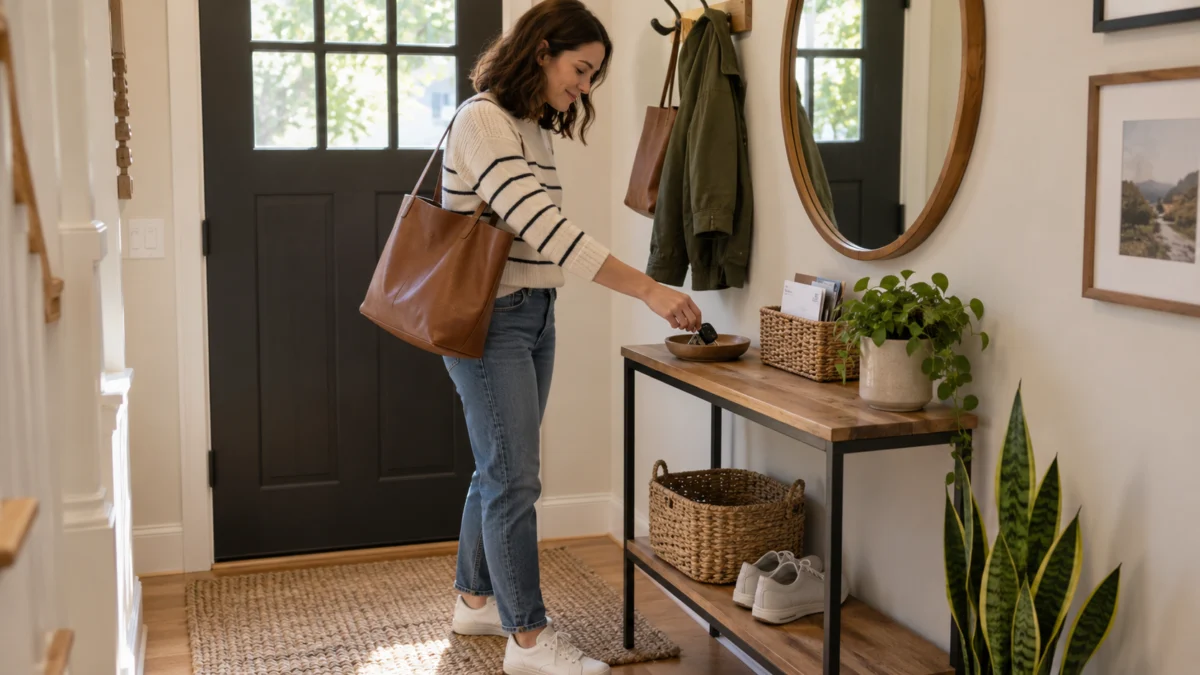
The keys that end up under a grocery receipt, the work bag left beside the sofa, and the umbrella leaning in a wet corner all create the same front-door problem: the things needed for the next trip out have split up. The delay is rarely dramatic. It is the repeated check of the kitchen bench, chair, bedroom and car that makes leaving feel more fiddly than it needs to be.
Trace the object that derails departure to its actual landing spot. If your keys nearly always hit the bench just inside the door, that bench is where a drop zone belongs. If a backpack is dropped beside the shoe rack, start there instead. A small drop zone works because it gives the objects involved in coming and going a visible place on the route they already take.
Build the landing place around the item that goes wandering
- Name the usual culprit. Pick one object that causes the most searching: house keys, car keys, an access fob, a work bag, sunglasses or a transport card. Begin with the item that creates a hold-up, rather than trying to organise the whole entry.
- Find its last believable landing point. Think about arriving home with hands full. Is the item put on a kitchen bench, a hall table, a shelf near the door or the floor beside a bag? Use that location, or one step closer to the door if there is a clear spot there.
- Match the holder to the object. Put a shallow dish, tray or open box where keys and cards land. Use a sturdy hook for a bag or jacket. Place a low washable tray or basket near the floor for damp umbrellas or shoes, if those regularly come inside that way.
- Keep the first version narrow. Reserve the space for daily carry items and, if needed, letters that have just arrived. Shift unrelated things off the surface: spare cords, old receipts, shopping bags and parcels make it harder to see what matters at departure time.
- Try one arrival and one departure. Come in with your usual load and use the setup. Next time you go out, collect what you need from it. If an item misses the spot, move the dish, hook or basket to where your hand naturally reaches.
A weekday setup beside a narrow entry bench
Mia enters her flat through the kitchen, carrying car keys, a tote bag, sunglasses and the post. Her keys keep ending up beside the kettle, while the tote goes onto a dining chair. In the morning, she finds the bag first, then walks back through the flat for the keys and sunglasses.
She clears one end of the narrow bench nearest the front door and puts a small bowl there for keys and sunglasses. A hook already fixed beside the door takes the tote bag. Letters go upright in a simple folder on the other end of the bench, away from the bowl. Her umbrella stays in a low plastic tray just inside the door after wet commutes.
The arrangement is not an entryway makeover. It gives four regular objects a distinct place: bowl, hook, folder and tray. A parcel delivered that afternoon still goes to the dining table to be dealt with later, rather than joining the keys.
Why a small front-door zone reduces the search
Arriving home is a transition with several things happening at once. You may be unlocking the door, carrying a bag, greeting someone, taking off shoes or putting down groceries. Objects are often placed wherever there is space, not where they will be useful tomorrow. That is ordinary behaviour, particularly in a busy household or a small home with limited surfaces.
A drop zone changes one part of that pattern by reducing the number of possible places to check. Keys do not require much storage, but they benefit from a holder that keeps them together and easy to see. A bag may need a hook because it is bulky and otherwise occupies a chair or passage. Wet gear needs separation so it does not soak paper, headphones or a work pass. Each part answers a particular problem caused by the object itself.
The location matters more than having matching containers. A handsome tray on a console across the hallway is of little use if everyone walks past it and puts keys on the bench. Starting with the existing landing point means the setup asks for a small adjustment, not a new route through the house.
It also helps to limit what the zone is expected to hold. Front-door areas can attract anything that lacks an immediate home: unopened mail, library books, school projects, coins, chargers and shoes from several people. Once the area becomes general storage, the daily essentials disappear into the same visual clutter. Keep the zone focused on objects that travel in and out often. Other items can have a separate destination elsewhere, even if that destination is simply a basket for later sorting.
If the first attempt does not work, treat the miss as useful information. Keys beside the bowl suggest the bowl is a hand-width too far away. A bag on the floor may mean the hook is too high, too weak or occupied by a jacket. Post piling up with the keys may mean it needs its own upright holder. Change the part that is being bypassed instead of adding more organisers.
Questions that come up at the door
What belongs in a front-door drop zone?
Keep daily departure items there: keys, access cards, sunglasses, a regular bag, a hat or umbrella. Incoming letters can sit nearby if they are separated from those essentials.
What if there is no hallway or entry table?
Use the closest workable point on the route in: one section of a kitchen bench, a shelf near the door, a hook on a suitable wall, or a small dish on a nearby bookcase. The space can be very small.
Should every person in the household have a separate spot?
Only if shared items become mixed up. Separate hooks or small trays can help with several sets of keys and bags, but a single shared tray is enough where that is all the household needs.
Stop once tomorrow’s essentials have an address
A finished drop zone does not need labels, new furniture or storage for every item near the entrance. Stop when the object that usually sends you searching has a holder at its real landing point, the bag is off the walkway, and wet or paper items are not mixed through the daily carry things. The next departure can begin at the front door instead of around the house.