
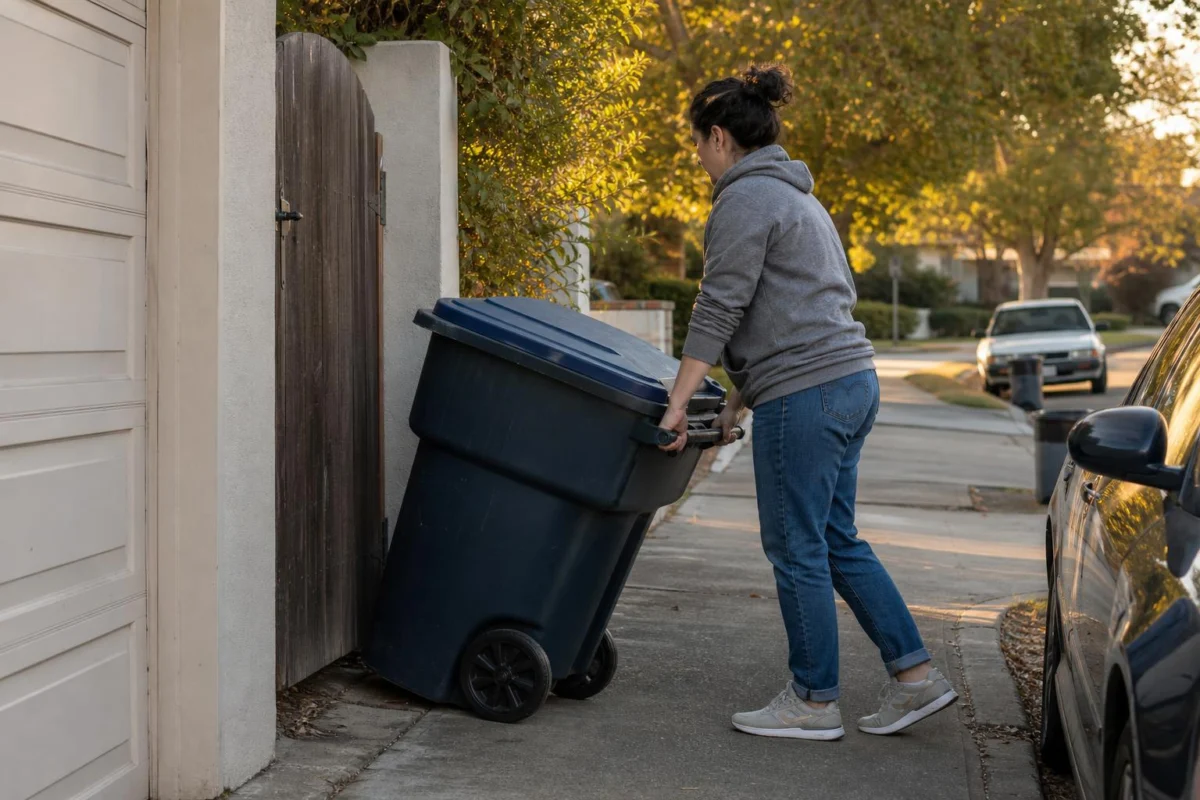
The trash cart is already telling you where a pickup-night reminder belongs. A cart parked behind the side gate, wedged beside the garage, or kept past a parked car creates one particular job: it has to travel from that spot to the curb before the collection truck arrives. The kitchen bag may be tied and the recycling may be sorted, yet neither matters if the cart stays in its usual parking place.
For the next pickup, test a reminder placed along the route to that cart. Rather than adding trash night to a long household list, use a note or other visible cue at the door, gate, or garage control you cross on an ordinary evening. The experiment has one result to check: did the cart that was due make it to the curb?
Test one cue on the cart’s path
- Confirm the morning’s collection. Check the schedule supplied by your city, building, homeowners association, or waste provider. Look for the exact material due: trash, recycling, compost, yard waste, or a combination.
- Stand where the cart is stored. Notice the route you must take to move it outside. You may need a side gate key, the garage-door button, a clear driveway, or a light after dark. This turns a vague evening task into a known physical trip.
- Pick one passing point for a cue. Use a place you reliably encounter after dinner, such as the inside garage door, the back-door handle, the dog-leash hook, or the gate latch. Skip the refrigerator if it is not on the route to the cart.
- Write what is due in plain words. A note reading Tuesday: black trash cart to curb is more useful than bins. If recycling changes by week, write check blue cart schedule so you look before rolling out both carts.
- Move the scheduled cart and only the ready waste. Add a tied kitchen bag or flattened cardboard that is already waiting nearby. Close the lid and position the cart according to local collection instructions, leaving access around it.
- Review the cue after collection. The next day, ask whether you encountered the reminder early enough and whether it named the right cart. Keep it where it worked, or shift it to the point where the evening route actually broke down.
A note that catches the side-gate trip
Marcus’s pickup is Thursday morning. His black trash cart sits behind a wooden side gate, while the blue recycling cart is collected every other week. On Wednesday evenings, he usually carries the dog’s leash from the mudroom, walks through the side gate, and returns without looking at either cart.
For one collection cycle, he clips a small card to the leash hook: Thursday: check black cart. After the dog walk, he checks the local schedule and sees that trash, not recycling, is due. He brings the full kitchen bag to the black cart, rolls it through the gate, and leaves the blue cart behind it. The next afternoon, the black cart is empty. The card stays on the leash hook because that was the point at which he was already beside the gate.
Why a route cue beats remembering at bedtime
Trash pickup has an awkward timing problem. The action belongs to the evening, but the consequence of forgetting it shows up early the next morning. By then, the truck may be gone, the cart is still by the house, and a week’s worth of waste may have to wait for the next collection. Remembering that pickup exists is not quite the same as carrying out the curbside part of the job.
A cue near the stored cart connects the reminder to the moment that requires a decision. At a garage door, you can check the schedule and see whether the cart is reachable. At a gate latch, you can notice a blocked path, a car in the way, or a missing flashlight. A general alert on a phone may prompt the thought of trash night, but the route cue points toward the object that must move.
Specific wording also helps with mixed collection schedules. Many homes have more than one cart, and those carts may not leave the driveway on the same weeks. Naming the color, material, or pickup day reduces the chance of hauling out a cart that is not due while overlooking the one that is. Keep the current schedule close enough to consult when the note asks you to check.
This is a small experiment rather than a household overhaul. One cycle can reveal whether the cue is visible, whether the cart’s parking spot is inconvenient, and whether the schedule is the confusing part. If you passed the note and still did nothing, place it later on the route or make the wording more direct. If you could not open the gate easily after dark, address that obstacle rather than adding more reminders elsewhere.
A phone notification can still be useful on evenings that look different because of work, travel, or school events. Give it a message that sends you toward the cart area, such as Check Thursday trash cart. Then use the posted schedule and the physical cue to settle which cart belongs outside. The notification supports the trip; it does not have to hold every detail.
Pickup-night reminder details
Where is the best place to put the reminder?
Put it where you naturally pass while still able to reach the cart, such as a garage-door button, back-door handle, leash hook, or gate latch.
What should the note say if several carts have different schedules?
Name the cart or material due and keep the current local calendar nearby. “Blue recycling cart?” invites a quick check without assuming every week is identical.
Should I roll out a partly full trash cart?
Follow local collection rules and your household’s needs. A partly filled cart can still be useful to empty before a busy week or schedule disruption.
What if someone else usually takes out the trash?
Use a shared cue that states the pickup night and cart type, then settle who handles it when the usual person works late, travels, or is sick.
End the task with the cart outside
For the next collection, start at the cart’s parking place and place one reminder on the path leading to it. Check what is due, move the correct cart to the curb, and leave the other one where it belongs. Once the lid is closed and the cart is waiting for collection, trash pickup night has its answer.